




How Much Energy Does a 400w Solar Panel Produce in Arizona?
 Last updated: Jun 26, 2026
 8 min read


Updated: June 17, 2026
Arizona enjoys over 300 sunny days a year. This abundant sunshine makes the state an ideal location for residential solar energy systems. Homeowners looking to reduce their utility bills frequently ask about the specific performance metrics of modern solar technology. Solar Topps will help guide you on your energy needs and usage.
A common question we hear is: exactly how much electricity does a solar panel produce? Knowing the answer helps you size your system correctly and predict your long-term financial savings. It also ensures you only pay for the equipment you actually need.
In this comprehensive guide, we will break down the expected solar panel output for a residential home in a desert climate. We will focus specifically on the highly popular 400w solar panel. By understanding the relationship between Watts, kilowatts, and kilowatt-hours, you can make an educated decision for your household.
Please Request a Residential Quote!
Understanding Watts, Kilowatts, and Kilowatt-Hours
Before calculating total energy production, you must understand the basic units of electrical measurement. Many homeowners confuse power with energy.
- Watts (W): This measures the instantaneous power capacity of a device. A 400w solar panel has a maximum power output of 400 Watts under ideal laboratory conditions.
- Kilowatts (kW): One kilowatt equals 1,000 watts. A system with ten 400-Watt panels has a total capacity of 4,000 Watts, or 4 kW.
- Kilowatt-hours (kWh): This measures the actual volume of energy generated or consumed over time. If a 1 kW solar system operates at full capacity for one hour, it produces 1 kWh of electricity.
When you look at your monthly utility bill, the electric company charges you based on the kilowatt-hours you consume. Therefore, when asking how many kwh does a solar panel produces, you are asking about the tangible energy that powers your home.
The Graph: Watts vs. kWh in Daily Production
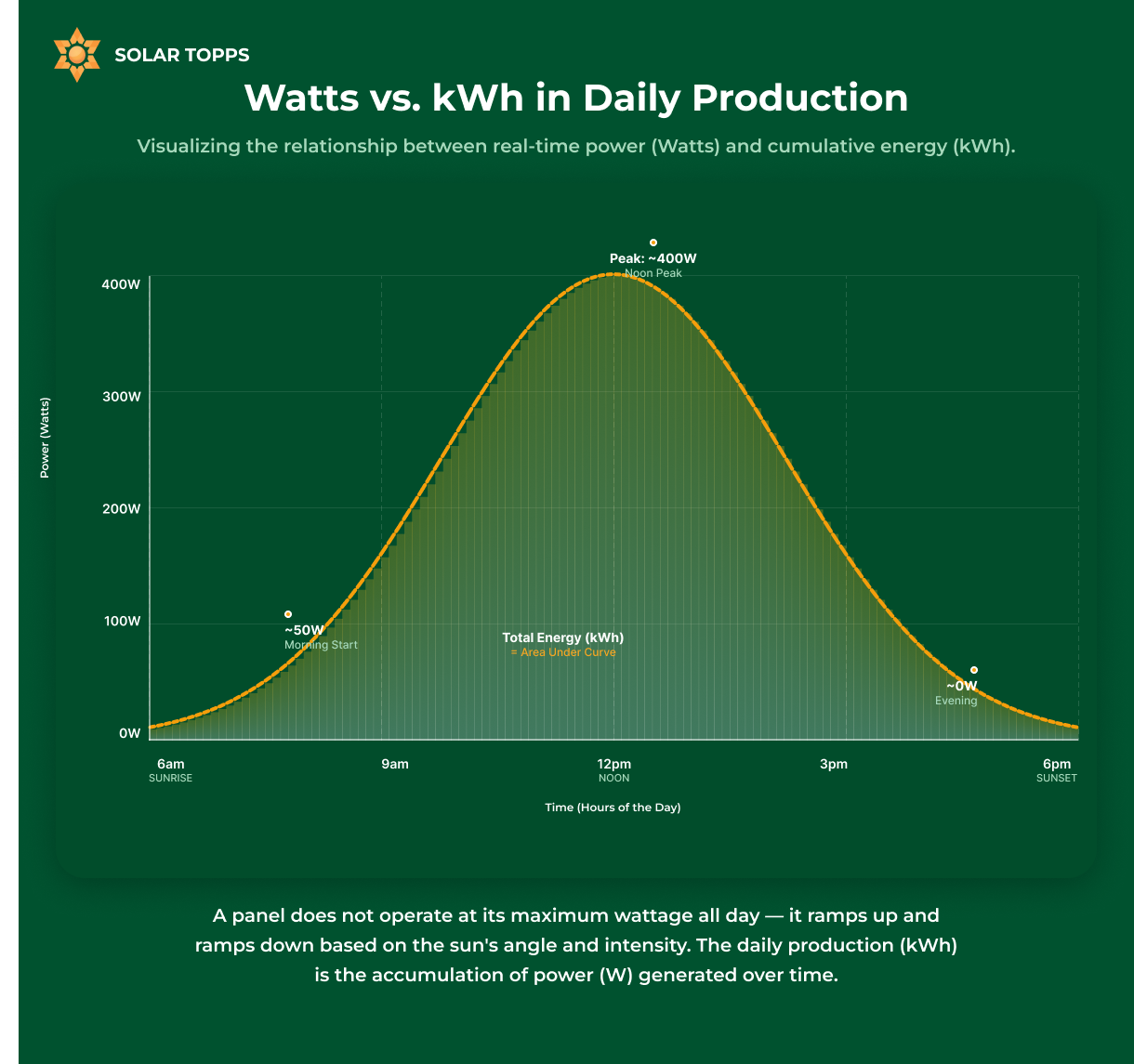
To visualize energy production, imagine a standard bell-curve graph charting a single day of sunlight.
The vertical axis represents Power (Watts), and the horizontal axis represents Time (Hours of the day).
- Morning: At sunrise, the panel generates a low amount of power, perhaps 50 Watts.
- Midday: By noon, as the sun reaches its peak, the panel approaches its maximum rating, producing close to 400 Watts.
- Evening: As the sun sets, the power output drops back down to zero.
The total area underneath this curved line represents the total energy produced for the day, measured in Watt-hours or kilowatt-hours. This graph clearly demonstrates that a panel does not operate at its maximum wattage for the entire day. Instead, it ramps up and ramps down based on the sun’s angle and intensity.
Solar Panel Production in Arizona
Solar panel output depends heavily on geographic location. Due to its latitude and clear skies, Arizona boasts some of the highest solar irradiance levels in the country.
Solar production is calculated using “peak sun hours.” A peak sun hour represents one hour of direct sunlight that offers 1,000 Watts of photovoltaic power per square meter. In Arizona, homes typically receive between 5.5 and 7 peak sun hours per day, depending on the season and specific location.
Using an average of 6 peak sun hours, we can calculate the daily yield of a 400w solar panel:
- 400 Watts x 6 peak sun hours = 2,400 Watt-hours.
- Divide by 1,000 to convert to kilowatt-hours = 2.4 kWh per day.
Over the course of a year, that single panel can generate approximately 876 kWh. If an average Arizona home consumes around 12,000 kWh annually, you would need about fourteen 400-Watt panels to fully offset that usage. Solar Panel Production in Arizona is highly efficient, allowing residents to use fewer panels to achieve complete energy independence compared to homeowners in northern states.
Evaluating Premium Equipment Options
Achieving optimal performance requires selecting high-quality equipment. We focus on providing premium products that are precisely engineered to deliver premium results. Two of the most reliable and efficient modules on the market are REC Alpha Pure Solar Panels and Panasonic Solar Panels.
REC Alpha Pure Solar Panels
The REC Alpha Pure series utilizes advanced heterojunction cell technology. This design captures more sunlight and performs exceptionally well in high-temperature environments. High heat can temporarily lower solar panel output, but REC panels feature a low temperature coefficient, meaning they suffer less performance degradation during intense Arizona summers. They also offer a sleek, completely black design that blends seamlessly with your roof.
Panasonic Solar Panels
Panasonic is a globally recognized brand synonymous with rigorous testing and long-term reliability. Panasonic Solar Panels consistently deliver high conversion efficiencies. They provide excellent power density, meaning you can generate more energy in a smaller physical footprint. Furthermore, Panasonic backs its modules with an industry-leading 25-year warranty covering performance, product, and labor.
Both of these options ensure that your 400w solar panel will withstand the harsh desert elements while maximizing your daily energy harvest.
The Importance of Professional Installation with Solar Topps in Phoenix, Arizona
Even the most advanced technology requires precise installation to function correctly. True solar panel output is influenced by roof orientation, pitch, and potential shading from nearby trees or structures.
South-facing roofs generally yield the highest production. However, west-facing panels are also incredibly valuable in Arizona, as they capture the late-afternoon sun when air-conditioning demand peaks. A highly accredited construction engineering team will evaluate your specific property to design a layout that maximizes your return on investment.
We take extreme ownership of every project phase. By integrating only solar specialists into our teams, we ensure that your system is engineered to exceed expectations. We do not accept excuses; we simply provide clean, reliable power.
Secure Your Energy Independence with Solar Topps today!
Understanding the mechanics of solar power gives you the confidence to upgrade your home. A 400-Watt panel is a powerful tool for reducing your reliance on the grid and locking in low energy costs for decades. By leveraging Arizona’s incredible solar resources and installing premium equipment, you can build a resilient, efficient home. If you want to go Solar, please Contact Us.
If you are ready to evaluate your property’s specific solar potential, contact our team of specialists today. We will provide a transparent, customized design using the industry’s best technology to ensure your absolute satisfaction.


