




Home Battery Storage Backup Guide: Costs & Benefits in AZ
 Last updated: Jun 10, 2026
 9 min read


Published: June 8, 2026
Quick answer: A home battery backup system stores solar or grid energy for use during outages or peak rate hours. In Phoenix, where summer outages are common and APS time-of-use rates can spike, pairing a solar battery backup system with solar panels delivers both energy security and long-term savings—typically ranging from $10,000 to $20,000+ before incentives.
Phoenix homeowners know the drill. Summer hits, temperatures push past 115°F, and the grid buckles under demand. When the power goes out, it’s not just an inconvenience—it can be a genuine safety risk. A backup battery for your house changes that equation entirely, giving you reliable power when you need it most.
This guide covers everything Arizona homeowners need to know about solar battery backup systems in 2026: how they work, what they cost, which batteries perform best in Phoenix’s heat, and how to take advantage of available incentives.
How Does a Solar Battery Backup System Work in Arizona?
A solar battery backup system captures excess electricity generated by your solar panels during the day and stores it for later use. In Phoenix, that means your panels are producing peak power from roughly 9 a.m. to 3 p.m.—often more than your home consumes. Without storage, that surplus gets exported to the grid at APS’s low avoided-cost rate. With a backup battery for solar panels, you keep that energy on-site and use it when grid rates are highest or when the power goes out.
There are three common configurations for Phoenix homeowners:
- Solar + battery: The most popular setup. Panels charge the battery during the day; the battery powers your home at night and during outages.
- Battery-only (no solar): Charges from the grid during off-peak hours and discharges during peak windows—useful for managing APS time-of-use bills.
- Off-grid: Rare in metro Phoenix, but viable for rural Maricopa County properties beyond utility reach.
According to the Solar Energy Industries Association, 40% of new solar systems installed in 2025 included energy storage—up from just 14% in 2023. That shift is accelerating in sun-belt markets like Phoenix, where solar production is high and grid stress events are frequent.
Why Phoenix Homeowners Are Choosing Battery Backup in 2026
Does battery backup make sense for Phoenix’s climate and utility rates?
Phoenix presents a compelling case for home battery storage on multiple fronts.
Grid reliability: APS and SRP have both reported increased outage frequency during peak summer demand. A whole home battery backup ensures your AC, refrigerator, and medical devices stay operational even when the grid doesn’t.
Time-of-use savings: APS’s current residential rate plans charge significantly more per kWh between 3–8 p.m. on weekdays. A solar battery backup system lets you discharge stored solar energy during those peak windows instead of drawing from the grid at premium rates.
Net metering changes: Arizona moved to a net billing structure, meaning APS pays substantially less for exported solar than the retail rate you pay to consume it. Storing your solar production and self-consuming it is now far more financially advantageous than exporting it.
According to a 2022 Lawrence Berkeley National Laboratory study, a 10 kWh battery paired with solar can power 86–100% of a home’s load through a 72-hour outage. A 30 kWh system extends that coverage to 92% even at day 10—critical for extended grid events during Arizona monsoon season.
Top Home Battery Options Available in Phoenix for 2026
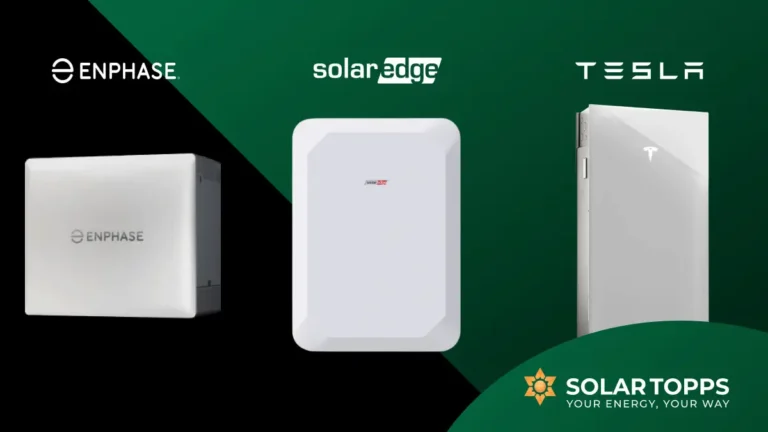
Not all batteries are built for desert conditions. Here are the three systems we install and stand behind for Phoenix-area homeowners.
Tesla Powerwall 3 for Arizona Residents
The Tesla Powerwall 3 is a fully integrated solar battery backup system with a built-in inverter, making it one of the cleanest installs available. It delivers 13.5 kWh of usable capacity and 11.5 kW of continuous power output—enough to run central air conditioning, essential appliances, and EV charging simultaneously.
The Powerwall 3 operates in temperatures up to 122°F, which matters when your garage or equipment closet regularly exceeds 100°F in July. Tesla’s app provides real-time monitoring, automated switching, and storm watch mode, which pre-charges the battery when severe weather is detected.
Best for: Homeowners who want a sleek, single-unit solution with strong software integration and whole-home backup capability.
Enphase IQ10C in Phoenix, Arizona
The Enphase IQ10C is a modular AC-coupled battery that pairs natively with Enphase microinverter systems. Each unit stores 10.08 kWh of usable capacity, and multiple units can be stacked for whole home battery backup coverage. The IQ10C operates at 100% depth of discharge—meaning you access every kWh you store, not a derated percentage.
Enphase’s Ensemble technology allows the system to operate independently from the grid with no critical load panel required in many configurations. Phoenix homeowners with existing Enphase solar systems find the IQ10C integrates seamlessly with minimal additional wiring.
Best for: Existing Enphase solar customers, homeowners who want scalable storage, and those prioritizing modular expandability.
FranklinWH Home Storage Battery
The FranklinWH aPower system offers 13.6 kWh of usable capacity per unit and is designed for whole-home backup without a subpanel. FranklinWH’s aGate gateway manages energy flow across up to 10 stacked units—providing up to 136 kWh of storage for large homes or energy-intensive properties.
Its single-phase and three-phase compatibility makes it a strong option for Phoenix homes with larger electrical loads. The system is rated for outdoor installation and performs reliably in high-ambient-temperature environments.
Best for: Larger homes, high-energy-use households, and homeowners who want to maximize backup capacity or plan for future expansion.
What Does a Solar Battery Backup Cost in Arizona?
Solar battery backup cost in Arizona depends on storage capacity, hardware brand, labor, and permitting. Here’s a realistic breakdown for Phoenix-metro installations in 2026:
|
System |
Estimated Installed Cost (Before Incentives) |
|---|---|
|
Tesla Powerwall 3 (13.5 kWh) |
$12,000 – $16,000 |
|
Enphase IQ10C (10.08 kWh) |
$11,000 – $15,000 |
|
FranklinWH aPower (13.6 kWh) |
$11,500 – $15,500 |
|
Multi-battery whole-home system |
$20,000 – $40,000+ |
These figures include hardware, labor, permits, and interconnection fees. The federal Investment Tax Credit (ITC) currently allows homeowners to deduct 30% of the total installed cost from federal taxes—reducing a $14,000 installation to an effective cost of $9,800. Batteries must be charged primarily from solar (at least 70%) to qualify.
APS and SRP periodically offer battery rebate programs; check with your installer for current availability, as these programs open and close based on funding.
How Much of Your Home Can a Battery Backup Actually Power?
This is the most common question we hear from Phoenix homeowners, and the honest answer depends on your consumption habits and the size of your system.
A single 13.5 kWh battery running essential loads—refrigerator, lighting, internet, phone charging, and a few outlets—can last 12–24 hours without recharging. Running central air conditioning reduces that window significantly, often to 4–8 hours depending on your AC unit’s efficiency and the outdoor temperature.
For extended outages, the solar-plus-storage combination is the key. Your panels recharge the battery each day, creating a renewable cycle that sustains backup power beyond the initial charge. According to the Lawrence Berkeley study cited earlier, a 30 kWh system with solar can meet 96% of a home’s power load—including cooling—through a three-day outage, and 92% through ten days.
For most Phoenix homeowners, one or two batteries paired with a properly sized solar system delivers meaningful outage protection without oversizing the investment.
Is a Whole Home Battery Backup Worth It in Phoenix?
The answer depends on three factors: how often you experience outages, how critical continuous power is to your household, and your current utility rate structure.
If you’re on APS’s Saver Choice Max or a similar time-of-use plan, a solar battery backup system typically pays for itself faster because the arbitrage value—charging cheap, discharging expensive—is significant. If your home includes medical equipment, young children, or elderly residents, the safety value of uninterrupted power may outweigh pure financial calculations.
Arizona’s solar incentive environment, combined with the 30% federal tax credit and declining battery hardware costs, makes 2026 one of the more favorable windows to invest.
Take the Next Step Toward Energy Independence
Topps Solar has been serving Phoenix-area homeowners since 2009. Our team of solar specialists designs and installs solar battery backup systems using only premium products—including the Tesla Powerwall 3, Enphase IQ10C, and FranklinWH—precisely engineered for Arizona’s desert climate.
Contact us today for a no-obligation assessment of your home’s energy needs and a transparent quote on a system built to perform when it matters most.
FAQ: Solar Battery Backup in Phoenix, AZ
What is the best backup battery for a house in Phoenix?
The Tesla Powerwall 3, Enphase IQ10C, and FranklinWH aPower are all strong performers in Arizona’s heat. The best choice depends on your home size, existing solar equipment, and backup goals. Whole-home coverage typically requires two or more units.
How much does a solar battery backup system cost in Arizona?
Most Phoenix homeowners pay between $11,000 and $16,000 per battery installed, before the 30% federal tax credit. Multi-battery whole-home systems can range from $20,000 to $40,000+.
Can I get a tax credit for a backup battery for solar panels in Arizona?
Yes. The federal Investment Tax Credit (ITC) covers 30% of installed costs for solar battery backup systems that are charged primarily from solar energy.
How long will a home battery backup last during a Phoenix power outage?
A single 13.5 kWh battery powering essential loads can last 12–24 hours. Paired with solar panels, the battery recharges daily—extending backup coverage through multi-day outages.
Do I need solar panels to install a home battery backup?
No. A standalone battery can charge from the grid and discharge during outages or peak rate hours. However, solar-plus-storage systems deliver the greatest financial return and the most reliable long-term backup capability.
Is a whole home battery backup viable in Phoenix’s extreme heat?
Yes, provided the system is rated for high-ambient-temperature operation. The Tesla Powerwall 3, Enphase IQ10C, and FranklinWH aPower are all certified for installation in hot climates and perform reliably in Phoenix’s summer conditions.


