




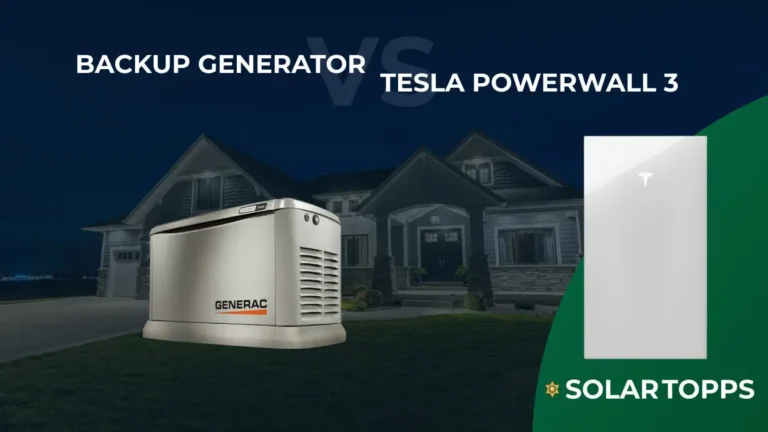
Tesla Powerwall 3 vs. Home Battery Backup Generators: What’s Best for Arizona Homes?
 Last updated: May 28, 2026
 10 min read


Updated: May 28, 2026
Arizona’s extreme heat and occasional monsoon storms make reliable power essential. When the grid goes down, your air conditioning stops, food spoils, and safety becomes a concern. For years, the traditional solution was a fossil-fuel backup generator. But today, the conversation has shifted. Homeowners are now choosing between conventional generators and advanced solar battery backup systems, such as the Tesla Powerwall 3. See the difference with Solar Topps, Arizona’s Top Rated Solar and Battery Company!
While both technologies aim to keep your lights on during an outage, they achieve this goal in vastly different ways. This guide breaks down the technical and practical differences between a Tesla Powerwall 3 and a standard backup generator to help you decide which is the best whole-home battery backup solution for your Arizona home.
Get a Free Quote for Your Powerwall 3 Today
Understanding the Contenders: Backup Generator Vs. Tesla Powerwall 3’s
Before diving into the comparison, it is crucial to understand what these two technologies are and how they operate within a residential electrical system.
What is an Electric Power Backup Generator?
A standby home generator is an internal combustion engine connected to your home’s electrical panel. When the grid fails, an automatic transfer switch (ATS) detects the loss of power, signals the generator to start, and switches the home’s load to the generator. These units run on fuel—typically natural gas, liquid propane, or diesel.
What is a Tesla Powerwall 3 Battery and Inverter?
The Tesla Powerwall 3 is a fully integrated AC battery system that stores energy for solar self-consumption, time-based control, and backup. It consists of a rechargeable lithium-ion battery pack, a liquid thermal control system, an integrated solar inverter, and software that intelligently controls electricity dispatch. It stores excess solar energy generated during the day to power your home at night or during grid outages.
Technical Deep Dive: How Generators Compare to Tesla Powerwall 3
To truly understand the difference, we need to look at the mechanics of operation, response time, and energy management. If you want to learn more about Solar Energy and Battery Storage, please read more About Us.
1. Response Time and Seamlessness For Arizona Homeowners
The Backup Generator Experience:
When an outage occurs, a generator does not kick in instantly. There is a delay—usually between 10 to 30 seconds—while the ATS senses the outage and the engine cranks up to reach the necessary frequency and voltage. During this gap, your lights go out, Wi-Fi disconnects, and sensitive electronics (like desktop computers) shut down hard.
The Tesla Powerwall Experience:
The Tesla Powerwall 3 creates a seamless transition. Its backup gateway disconnects the grid and engages the battery in a fraction of a second. This happens so fast that most appliances, including clocks and routers, stay running without interruption. You likely won’t even notice the power went out until you receive a notification on the Tesla app.
2. Fuel Source and Energy Independence
Power Backup Generators:
Generators rely on a finite fuel supply. If you run on natural gas, you are tethered to the utility line. If a natural disaster damages gas lines (which can happen during earthquakes or severe storms), your generator becomes a lawn ornament. If you use propane or diesel, you are limited by the size of your tank. Once it runs dry, you are out of power until a delivery truck can reach you.
Powerwall 3:
The Powerwall 3 pairs with solar panels to create an infinite energy loop. During the day, your solar system powers your home and recharges the Powerwall. At night, the Powerwall runs your home. Even during a multi-day grid outage, as long as the sun shines, your system recharges daily. This provides true energy independence without relying on utility infrastructure or fuel deliveries. We can help you understand how many Tesla Powerwall 3’s you will need for your Arizona home.
3. Noise and Maintenance
Generators:
Generators are mechanical engines. They vibrate, produce exhaust fumes, and are notoriously loud—often exceeding 70 decibels, which is equivalent to a vacuum cleaner running constantly outside your window. They also require “exercise” cycles (running briefly every week) and regular maintenance, including oil changes, filter replacements, and spark plug checks.
Tesla Powerwall 3:
The Powerwall is solid-state technology with no moving parts. It operates silently, making it ideal for residential neighborhoods where noise ordinances or HOA rules apply. It requires no active maintenance from the homeowner. The liquid thermal control system regulates internal temperatures to ensure longevity and safety in Arizona’s high heat.
The Solar Topps Comparison at a Glance
Here is a technical breakdown of how the Tesla Powerwall 3 stacks up against a standard residential standby generator. If you have more questions about these comparisons, you can always Contact Us.
Feature |
Tesla Powerwall 3 |
Standard Standby Generator |
|---|---|---|
|
Fuel Source |
Solar Energy (Unlimited) |
Natural Gas / Propane / Diesel (Finite) |
|
Noise Level |
Silent |
Loud (60-75+ decibels) |
|
Maintenance |
None (Automated software updates) |
High (Oil, filters, spark plugs) |
|
Response Time |
Instant (Seamless transition) |
Delayed (10-30 seconds) |
|
Grid Services |
Can sell energy back / TOU arbitrage |
None |
|
Emissions |
Zero emissions |
CO2 and exhaust fumes |
|
Warranty |
10 Years |
Typically 3-5 Years |
|
Incentives |
Eligible for Federal Tax Credit (30%) |
Generally not eligible |
The Powerwall 3 Advantage: Why It Wins in Arizona
For Arizona homeowners, the Powerwall 3 offers specific advantages over generators that go beyond simple backup.
Load Management and “Start” Capability
One of the biggest technical leaps in the Powerwall 3 is its ability to handle high “inrush currents.” In layman’s terms, this means it can start heavy loads like air conditioners. The Powerwall 3 has a continuous power output of 11.5 kW, which is significantly higher than previous battery generations. This allows a single unit to back up most homes, including the A/C, without needing a massive bank of batteries.
Financial Return on Investment (ROI): Solar Panel Battery Energy
A generator is an insurance policy; it sits idle 99% of the time, costing money in maintenance and fuel without generating value. A Tesla Powerwall works for you every day. Through Time-of-Use (TOU) load shifting, the Powerwall can power your home during peak utility rate hours (when electricity is most expensive) using stored solar energy. This reduces your monthly bill, helping the system pay for itself over time—something a generator can never do.
Solar Energy System Integration and Monitoring
The Tesla ecosystem allows for granular monitoring via the mobile app. You can view real-time energy usage, solar production, and battery levels. You can also customize your backup reserve, telling the system exactly how much power to save for emergencies versus how much to use for daily bill savings. Generators generally offer limited visibility and control.
Making the Smart Choice for Your Arizona Home
While generators have a long history, they represent old technology. They are reactive, loud, and maintenance-heavy. The Tesla Powerwall 3 represents the future of home energy resilience. It is proactive, silent, and integrates seamlessly with solar to provide a clean, renewable energy source that protects your home and your wallet.
If you are looking for the best solar battery backup for Arizona homes, the choice is clear. The Powerwall 3 offers a level of sophistication, reliability, and long-term value that a fossil-fuel generator simply cannot match.
Stop relying on an unstable grid and finite fuel sources. Take control of your energy future with a solution designed for performance and longevity with Solar Topps.


